Electric scooter charging time: how long it takes, fast chargers and cost per charge
Small commuters charge in an afternoon and big performance models take most of a day. Here is how to work out your own charging time, and what each charge really costs.
Published Oct 8, 20267 min read
CHARGE
The short answer
Electric scooter charging time depends on two things: battery size and charger output. By the makers’ figures, light commuters take about 3 to 8 hours and large models with 1,000Wh or more take about 6 to 12 hours on the included charger. For a rough estimate, divide the battery’s amp hours by the charger’s amps. A fast charger from the maker, or a second charger on a dual port, can cut the wait sharply. A full charge costs only cents in electricity.
Small commuter batteries charge in about 3 to 8 hours. Big performance packs take about 6 to 12 hours on the included charger.
Amp hours divided by charger amps gives a rough charging time, and the last part of a charge is always the slowest.
Fast chargers and dual charging ports can halve the wait. Only use ones the maker sells for your model.
At an example rate of 20 cents per kWh, a full charge costs about 6 cents for a small commuter and well under a dollar for a big model.
What decides electric scooter charging time
Two numbers decide it: how much energy the battery holds and how fast the charger puts it back. Battery size is listed in watt hours (Wh), or as volts and amp hours (Ah). Charger output is printed on the charger label, such as 42V 2A.
For a rough estimate, divide the battery’s amp hours by the charger’s amps. The Kaabo Mantis 10 Lite has a 48V 13Ah battery and a 2A charger. 13 divided by 2 is 6.5, and Kaabo lists about 6.5 hours. The Kaabo Warrior X Max has a 27Ah pack and two 1.75A chargers, 3.5A together, which works out to about 7.7 hours against Kaabo’s figure of about 7.8.
The last part of a charge is the slowest. As the battery nears full, the charger slows down to top up the cells gently. E-TWOW’s figures show it clearly: the TankTorq TK3 reaches 50% in 1 hour and 100% in 2.5 hours, and the GT Sport reaches 50% in 1.5 hours and 100% in 3.5 hours. Some makers publish quicker or slower figures than the simple math, so the product page is the number to trust.
How long common electric scooters take to charge
Here is what makers list for models in our catalog, grouped by battery size. Times run from empty to full on the charger that comes in the box.
Two scooters with similar batteries can charge at very different speeds. The charger makes the difference, which is why it pays to check the charging time on the product page before you buy.
Electric scooters mentioned in this guide. Each product page lists the maker charging time.
Maker figures, checked September 2026. Real range and speed depend on rider weight, terrain, temperature and riding mode.
Fast chargers and dual charging ports
A stronger charger is the only real way to cut charging time, and it has to come from the maker of your scooter. Many performance models offer one, and some have two charging ports so two chargers can work at once.
Kaabo: the Warrior X Max drops from about 7.8 hours on its two included chargers to 2.7 hours with two 5A chargers. The Kaabo King GTR goes from about 8.5 hours to 3.5 hours the same way.
YUME: the YUME Raptor2 comes with two 2A chargers for about 7 to 8 hours on its dual ports. YUME also sells a 5A fast charger rated at about 6 hours and a 10A fast charger at about 3 hours.
E-TWOW: the TankTorq TK2 and TK3 ship with a 60V 4A charger, and E-TWOW offers an optional 8A fast charger.
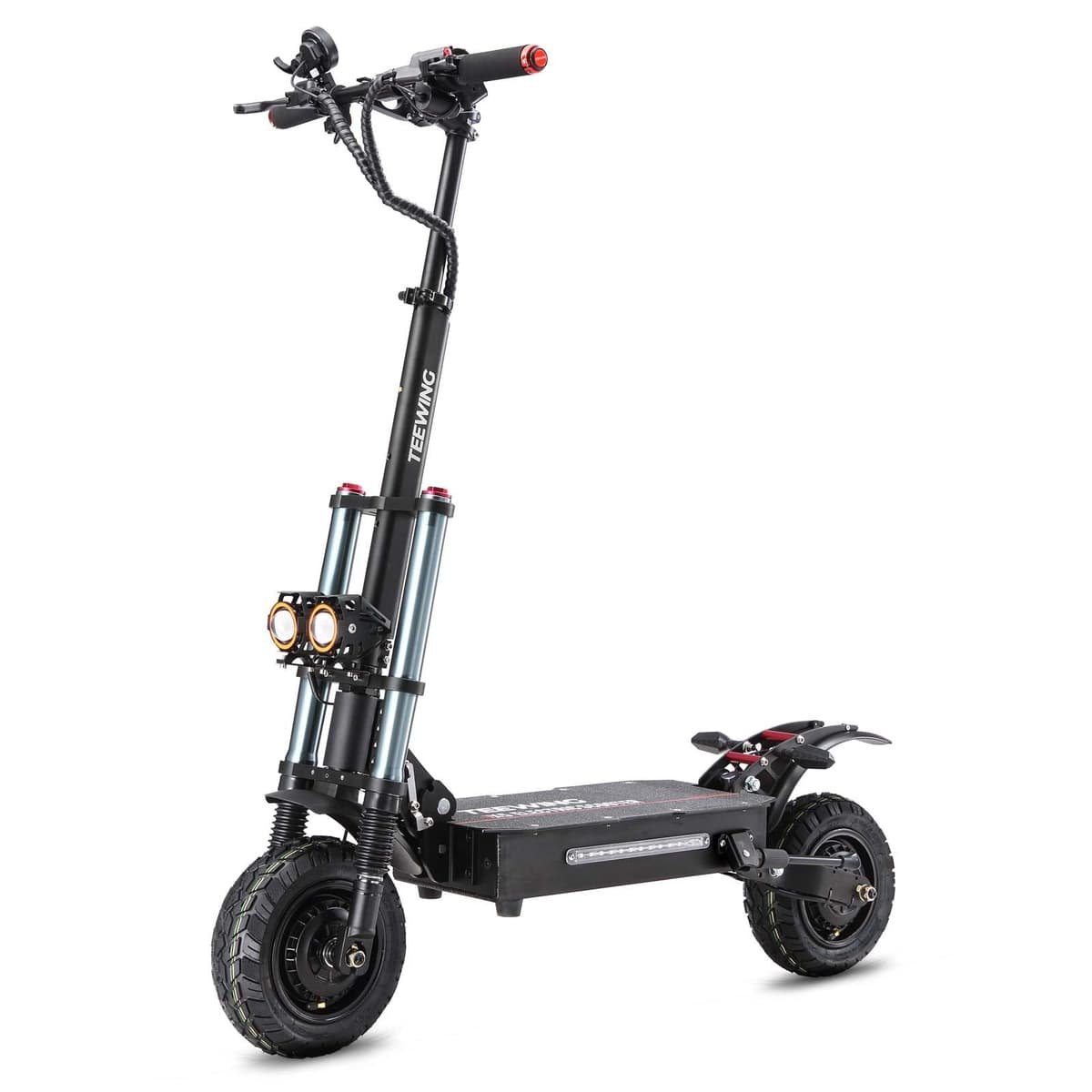
A second standard charger: the Teewing X5 takes 7 to 8 hours on one charger and 4 to 6 hours on two. The Miniwalker Tiger 10 Pro+ takes 10 hours, or 6 with two chargers.
Fast charging makes more heat. Use the fast charger when you need a quick turnaround and the standard charger when you have time. Never use a charger made for a different model, even if the plug fits: the wrong voltage can damage the battery or start a fire.
What a full charge costs
Charging an electric scooter costs very little. You can work it out in three steps from the battery size on the product page and the rate on your electricity bill.
Find the watt hours. If the spec sheet only gives volts and amp hours, multiply them: 48V x 13Ah = 624Wh.
Convert to kilowatt hours and allow for losses. Divide by 1,000, then add about 10% as a rough allowance for energy the charger loses as heat.
Multiply by your rate. Your bill shows what you pay per kWh.
A worked example, using an example rate of 20 cents per kWh (your own rate will differ): the Segway Max G3 has a 597Wh battery. That is about 0.6 kWh, or about 0.66 kWh with losses, so a full charge from empty costs about 13 cents. If that charge carries you 25 miles, you pay about half a cent per mile.
A 275Wh commuter such as the Segway E2 Pro: about 6 cents at the same example rate.
Top ups cost even less, since you only pay for the energy you put back. Your real cost per mile depends on rider weight, speed, hills and cold. Our guide to how far an electric scooter really goes shows how to estimate your own miles per charge.
Ways to spend less time waiting
Top up instead of running it flat. Plugging in at 30 or 40% means a much shorter session than charging from empty, and lithium-ion batteries do not mind short top ups.
Keep the charger with you. A padded case such as the E-TWOW charger bag carries the GT Sport or Booster ES charger on the scooter, so you can top up at work or at a friend’s place.
Choose a removable battery if you cannot charge where you park. The NANROBOT X8 has a removable 36V 10.4Ah battery you can carry inside, and the KUKIRIN G3 Pro has a removable pack with a dual charging port.
How long does it take to charge an electric scooter?
By the makers’ figures, light commuters take about 3 to 8 hours and large performance models about 6 to 12 hours on the included charger. The product page for your model lists its charging time.
Can I use a faster charger on my electric scooter?
Only if the maker sells one for your model. A charger with the wrong voltage can damage the battery or cause a fire, even if the plug fits.
How much does it cost to charge an electric scooter?
Multiply the battery size in kWh by your electricity rate and add about 10% for charger losses. At an example rate of 20 cents per kWh, a 597Wh battery costs about 13 cents to fill from empty.
Why does the last part of the charge take longer?
As the battery nears full, the charger slows down to top up the cells gently. E-TWOW, for example, lists 50% in 1 hour and 100% in 2.5 hours for the TankTorq TK3.
Should I charge my electric scooter after every ride?
You can. Short top ups do no harm to a lithium-ion battery, and they save you long charges from empty. Just do not leave it charging while nobody is home.
Most electric scooters have two to five speed modes, and they change more than top speed. Here is what each mode does, how limits and apps work, and which settings suit a new rider.
No oil changes, but the chain, brakes, tires and suspension work harder on a dirt bike than on almost anything else you own. Here is what to check before you ride, after you ride and once a month.
Two digits tell you how well an electric scooter keeps out dust and water. Here is what each common rating means, what the tests never cover, and which models carry which rating.
Oct 9, 20266 min read
Ready to look at models?
Shop the rides
30+ brands and 200+ models, with free shipping to the 48 contiguous states. Stuck between two? Our AI assistant answers calls and texts any time at (240) 916-2471.