Can you take an electric scooter on a plane? Battery rules and better ways to travel
Airline battery rules are written in watt hours, and almost every adult electric scooter carries far more than they allow. Here is what TSA and the federal rules say, how to read your battery, and how to travel with a scooter by car or train instead.
Published Oct 11, 20268 min read
FLY
The short answer
Can you take an electric scooter on a plane? In most cases, no. The federal rules for passengers (49 CFR 175.10) let a device’s lithium ion battery go up to 100 watt hours, or up to 160 Wh with the airline’s approval. Even the smallest adult scooters we carry hold about 180 Wh or more, so they sit above that line. TSA says to check with your airline for battery-powered rides like hoverboards, and the airline has the last word. For most trips, drive it, take it on a train that allows it, or have one shipped to where you are going.
Air travel battery rules are set in watt hours (Wh): volts times amp hours.
The passenger rules stop at 160 Wh, and that level needs the airline’s approval. Adult electric scooters in our catalog start at about 180 Wh.
TSA says to check with your airline for hoverboards and similar rides, and the final call at the checkpoint rests with the TSA officer.
A car trunk, a train that accepts folding scooters, or a delivery to your destination are the realistic options.
What the official rules say
Two official sources decide what goes on a US flight: the federal hazardous materials rules and TSA screening. We read both before writing this guide. This is general information, not legal advice, and rules change, so confirm the current version and your airline’s own policy before you pack.
The federal rules (49 CFR 175.10, from the US Department of Transportation’s Pipeline and Hazardous Materials Safety Administration). Portable electronic devices powered by lithium batteries may travel in checked or carry-on bags. A lithium ion battery must not exceed 100 Wh. With the approval of the operator (the airline), a device may contain a battery of more than 100 Wh but not more than 160 Wh.
Devices in checked bags. The same rule says a device in a checked bag must be completely switched off.
Spare batteries. Spares go in carry-on bags only, each protected against short circuit. With airline approval you may carry no more than two spares of 101 to 160 Wh each.
TSA’s pages on lithium batteries. TSA says spare lithium ion batteries, including power banks, must be in carry-on bags only, that the 100 Wh limit covers nearly all batteries in everyday electronics, and that larger spares of 101 to 160 Wh need airline approval, with a limit of two per person.
TSA’s page on hoverboards. For both carry-on and checked bags, TSA’s answer is “Check with Airline”. Hoverboards may pass the checkpoint, but the airline sets its own policy.
The examples in the federal rule are phones, cameras, laptops, watches and medical devices. It does not name electric scooters at all, which is why the airline’s own policy matters so much. TSA also notes that the final decision on any item at the checkpoint rests with the TSA officer. The FAA publishes passenger battery guidance on its PackSafe pages, and your airline’s dangerous goods page is the place to confirm what it accepts.
Always confirm with your airline before you go to the airport. Airlines set their own policies on top of the federal rules, and an airline can say no even when a battery is under the limit. Ask in writing, and keep the reply with your booking.
How to work out your battery’s watt hours
Multiply the battery voltage by its amp hours. A 36V 5Ah battery holds 180 Wh. A 48V 10Ah battery holds 480 Wh. Some makers print the Wh figure on the product page or the battery label, and our battery voltage guide explains volts, amp hours and watt hours in more depth.
Here is how the lightest adult scooters in our catalog compare with the 100 and 160 Wh lines:
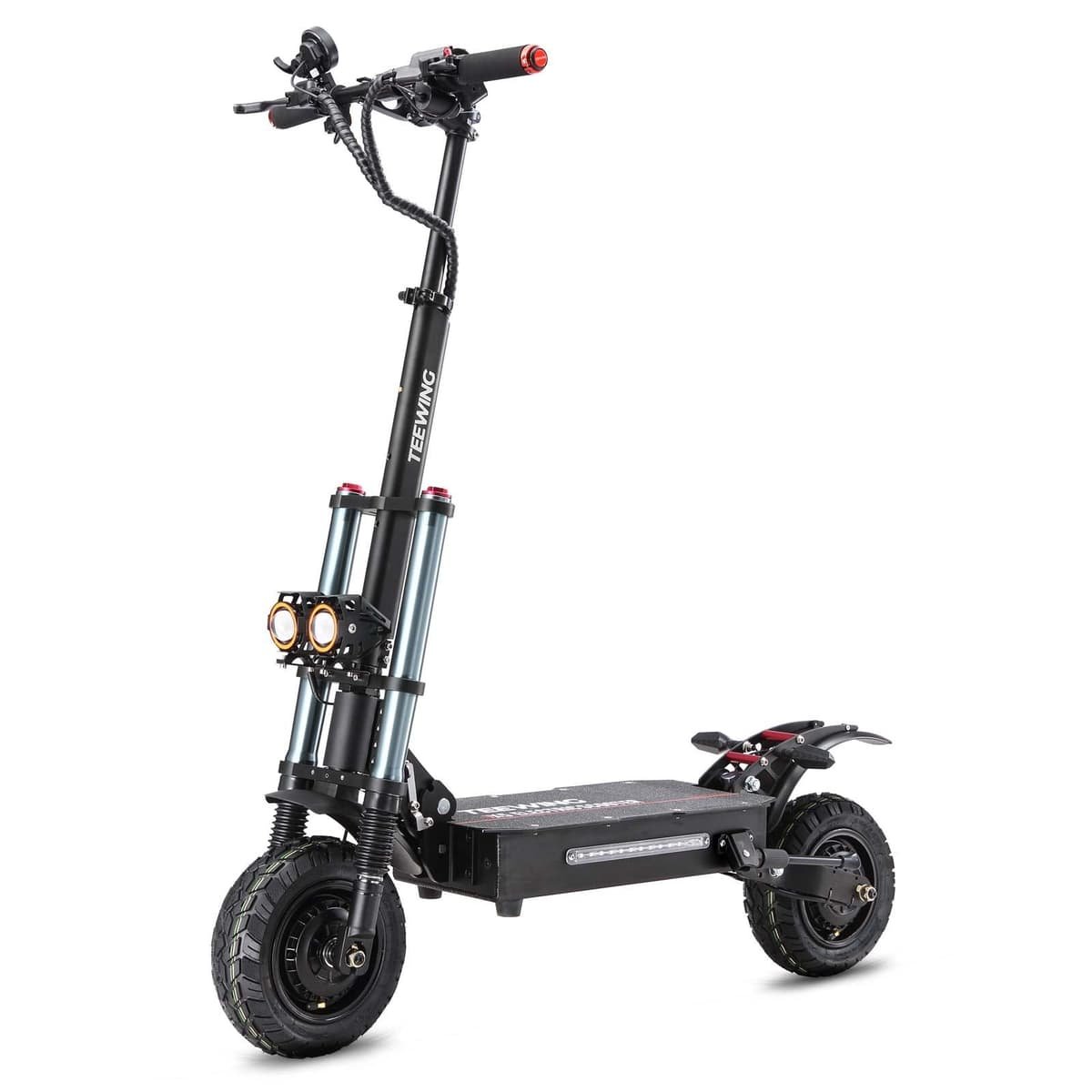
Teewing X6 Backpack: a 36V 5Ah battery, about 180 Wh. It weighs 22 lb and folds into its own backpack, and it still sits above 160 Wh.
Commuter and performance models go far higher, often 500 to 3,000 Wh. So for adult electric scooters, the honest answer is that the battery is too big for the passenger rules, even before the airline’s policy comes into it.
A few small kids’ models sit lower. The NANROBOT K1 runs a 22.2V 2.6Ah battery, about 58 Wh. Even then, a scooter is not one of the devices the federal rule lists, so whether it flies is your airline’s decision.
Never open, remove or swap a battery to get under a limit. Scooter batteries are built for the frame, wiring and BMS of one model. Work on a battery belongs with a qualified technician, and opening one can void the warranty.
What about mobility scooters?
The federal rule has a separate section for wheelchairs and battery-powered mobility aids used by passengers with disabilities. For a lithium ion mobility aid whose battery is not adequately protected by the device, that section allows a battery of up to 300 Wh, carried in the cabin, plus one spare of up to 300 Wh or two spares of up to 160 Wh each.
That section is written for mobility aids, not for scooters bought to commute or ride for fun. If you use a mobility device, contact the airline’s accessibility desk well ahead of your flight. The stand-up and seated electric scooters we sell are not medical mobility devices.
Driving: the easiest way to bring your scooter
A car trunk takes almost any folding electric scooter, and no battery limit applies. Measure the trunk against the folded size on the product page, lay the scooter on a blanket, strap it so it cannot slide, and keep it out of a hot or freezing car for long stops. Our guide to transporting an electric scooter in a car covers lifting, loading, racks and battery care step by step.
Each rail and bus operator sets its own rule, so read it before you buy your ticket. As one example, Amtrak’s page on special items in baggage says:
E-bikes and folding scooters up to 50 lbs may travel, with a maximum tire width of 2 inches on most routes (2.5 inches on the Capitol Corridor and Gold Runner, 4 inches on the Pacific Surfliner).
Folding scooters must be folded and compacted before boarding, and stored between your legs, under your seat or in areas for folding bikes.
Non-folding scooters are accepted only where checked baggage service is offered.
The vehicle and its battery must carry certification from a nationally recognized testing laboratory, such as UL or CSA Group.
No charging onboard or on Amtrak property, and the scooter must be powered off while you travel.
Amtrak’s list of prohibited items also bars hoverboards, Onewheel boards and self-balancing scooters from stations and platforms. Rules differ by route and change over time, so check the page for your train.
City buses, subways and intercity coaches each have their own policies, and some restrict scooters at busy hours. A light scooter is far easier on any of them. Our backpack electric scooter guide covers carrying a small scooter on stairs and platforms, and lightweight electric scooter picks lists the lightest models we stock.
Other ways to have a scooter at your destination
Have one shipped there. If you are moving or staying a while, order to that address. Every order ships free to the lower 48 states, and orders placed by 2 PM ET ship in 1 to 2 business days.
Rent or share locally. Many cities have shared scooters for short stays. Check the local rules on where they may be ridden.
Leave it at home and plan the return. For a short trip, a scooter in the trunk of a friend’s car, or no scooter at all, is often simpler than an airline exception.
A short checklist before any trip
Work out your battery’s watt hours: volts times amp hours.
Read your airline’s dangerous goods or special items page, and ask the airline in writing.
For a train or bus, read that operator’s current rules on weight, folding, tire width and charging.
Fold it, switch it off and protect the controls before you travel.
Never modify, remove or swap the battery to fit a rule.
Usually not. The federal passenger rules cap a device’s lithium ion battery at 160 Wh even with airline approval, and adult electric scooters in our catalog start at about 180 Wh. Ask your airline before you go.
Can I fly with just the scooter battery in my carry-on?
Spare lithium ion batteries must go in carry-on bags, and TSA and the federal rules allow spares above 100 Wh only up to 160 Wh, with airline approval and no more than two. A scooter battery is almost always larger than that, and you should never remove a built-in battery yourself.
How do I find the watt hours of my electric scooter battery?
Multiply the voltage by the amp hours. A 36V 7.8Ah battery is about 281 Wh. Many product pages and battery labels list the figure directly.
Can I take an electric scooter on Amtrak?
Amtrak’s special items page says folding scooters up to 50 lbs may travel if folded, with tire width limits, a battery with certification from a nationally recognized testing laboratory, and no charging onboard. Check Amtrak’s current page for your route before you travel.
What is the best way to travel with an electric scooter?
By car for most trips: no battery limit applies. Our car transport guide shows how to load and secure it.
Sag is the first setting that makes adjustable suspension work for your weight. Here is how to measure it with a tape and a friend, what preload, compression and rebound do, and where home setup should stop.
Tire pressure changes grip, comfort, range and flats more than any other quick adjustment. Here is how to find and set it, how to read a dirt bike tire size, and the sizes our bikes use.
A safe charging routine, the charge times each maker lists, why many quote 20% to 80%, how to match the charger, and what to do if a battery looks or smells wrong.
Oct 11, 20267 min read
Ready to look at models?
Shop the rides
30+ brands and 200+ models, with free shipping to the 48 contiguous states. Stuck between two? Our AI assistant answers calls and texts any time at (240) 916-2471.