Electric scooter parts explained: motor, controller, battery, BMS, throttle and brakes
Every electric scooter is built from the same core parts. Knowing what each one does makes spec sheets easier to read and tells you which parts wear out and which ones should last.
Published Oct 11, 20267 min read
PARTS
The short answer
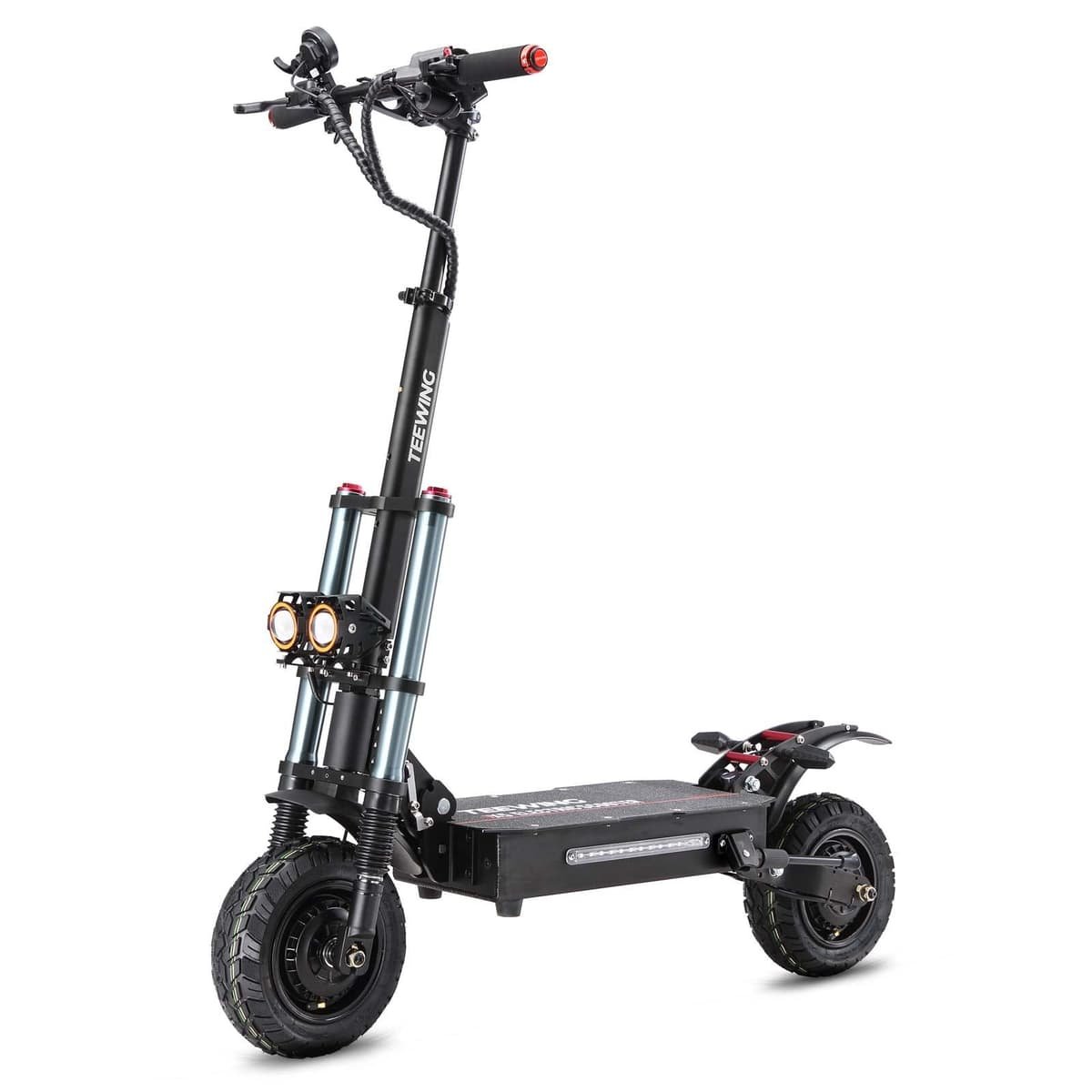
The main electric scooter parts work as one chain. The battery stores energy, and its BMS (battery management system) protects the cells. The controller takes that energy and feeds the motor as much as the throttle asks for, while the display shows speed, battery and mode. Brakes, tires and suspension handle stopping, grip and comfort, and the stem, deck and folding latch hold it all together. Tires and brake pads wear with use; the motor, controller and battery should last for years, and faults there are warranty and technician work.
Battery, BMS, controller and motor form the power chain. The throttle tells the controller how much power to send.
Volts times amp hours gives the battery’s watt hours, the fairest way to compare range.
Tires, brake pads and grips are wear parts. The motor, controller and battery should not wear out quickly.
Power off and follow the maker’s manual. Battery, controller and wiring work belongs with a qualified technician.
How the parts work together
An electric scooter is a power chain on a folding frame. When you press the throttle, the controller reads the signal, draws current from the battery and sends it to the motor, which turns the wheel. The BMS watches the battery the whole time, and the display shows you what is happening. Brakes, tires and suspension do the rest.
Reading a spec sheet is easier once you know which line belongs to which part. Here is each one in turn, with examples from listings in our catalog.
The motor
Almost every electric scooter uses a brushless hub motor built into the wheel. It has no chain or belt, so there is little to maintain. A single motor model drives one wheel, usually the rear. A dual motor model has one in each wheel for more grip and climbing.
Listings give a rated power, which the motor can hold, and a peak power for short bursts. The INMOTION Climber lists 450 W x 2 rated and 750 W x 2 peak. The E-TWOW TankTorq TK2 Lite puts a 600W motor (950W peak) in the rear wheel. Our guide to electric scooter watts explains rated and peak power in full, and single vs dual motor covers the trade-offs.
The controller
The controller is the scooter’s power manager. It sits in the deck or stem, reads the throttle, brake levers and speed mode, and decides how much current reaches the motor. It also handles speed limits, cruise control and the electronic brake.
Amps. A higher amp rating lets more current through, which means harder acceleration. The INMOTION RS Midnight lists dual 50A sine wave controllers, and the Kaabo Wolf King GTR Max a 72V 100A unit.
Sine wave and FOC. Sine wave and FOC (field oriented control) controllers drive the motor smoothly and quietly. Many performance listings name one of them.
Weather sealing. E-TWOW lists a waterproof connection on the TK2 Lite’s 950W 60V controller.
The battery
The battery is the fuel tank, and usually the most expensive single part. It is a pack of lithium ion cells, often the 18650 or 21700 sizes, wired to reach a set voltage.
Volts (V) set how hard the motor can push. Commuter models run at 36V or 48V, and performance models at 60V or 72V.
Amp hours (Ah) describe how much charge the pack holds.
Watt hours (Wh) are volts times amp hours, the real size of the tank. The E-TWOW TankTorq TK5 lists 60V 21Ah (1260Wh).
Cells. Some makers name them. YUME lists Samsung 21700 cells in the XTRON, and the INMOTION Climber lists 21700 lithium cells in a 533 Wh pack.
Our guide to battery voltage goes deeper on 36V to 72V, and battery care covers charging and storage habits that help a pack last.
The BMS (battery management system)
The BMS is a circuit board inside the battery pack that protects the cells. It cuts power if the pack is overcharged, drained too low, pushed past its current limit or getting too hot, and it keeps groups of cells at matching levels.
The NAVEE V25 Pro lists a smart BMS with 6 protections.
The INMOTION Climber lists a smart BMS with cell balancing.
When a scooter shuts off on a steep hill or with a low battery, the BMS is often doing its job. The TK2 Lite, for example, limits speed to 7.5 mph once the battery drops under 10%.
The charger
The charger turns wall power into the exact voltage your battery needs. Its output voltage is higher than the battery’s nominal figure: the INMOTION Climber’s 36V pack uses a 42V 2A charger, and the Kaabo Wolf King GTR Max’s 72V pack two 84V 1.75A chargers.
More amps charge faster. E-TWOW lists the TK2 Lite’s 60V 4A charger at 50% in 1 hour and 100% in 2.5 hours, and YUME sells a 10A fast charger for the XTRON separately. Use only the supplied charger or the maker’s own replacement.
Display, throttle and controls
Display. Shows speed, battery level, speed mode and error codes. It can be a simple LED readout of speed and battery, as on the NANROBOT H1, or a color screen, like the TK2 Lite’s 2.8 in outdoor TFT display or the XTRON’s 3.5 in TFT with navigation.
Throttle. A thumb throttle, as on the INMOTION Climber, is the most common. INMOTION lists a half twist throttle on the RS Midnight, and YUME includes both a thumb and a twist throttle with the XTRON.
Brake levers. Most cut the motor the moment you pull them, before the brakes bite.
Buttons, apps and locks. Speed modes, lights and horn sit on the bar. Many models add an app, an NFC card or a key to start.
Our guide to speed modes explains what the mode button changes.
Brakes, tires and suspension
Brakes. Drum, mechanical disc, hydraulic disc and electronic or regenerative braking, often two together. The INMOTION Climber pairs a rear disc with front and rear electronic braking, and the TK2 Lite pairs a front drum, a rear disc and regenerative braking. Our brakes guide compares every type.
Tires. Air-filled tires, tubed or tubeless, grip and cushion best. Solid tires never go flat but ride harder. The Climber uses 10 in tires with an inner tube, and the TK2 Lite 9 in tubeless self-sealing tires.
Suspension. Springs, hydraulic shocks or rubber elastomers between the wheels and the deck. The TK5 lists adjustable hydraulic suspension front and rear. See electric scooters with suspension.
Stem, deck, folding latch and lights
The frame parts carry you and keep the steering tight. The stem holds the handlebar, the folding latch locks the stem upright, and the deck carries your feet and usually the battery and controller underneath. Any play in the stem or latch is a safety issue; tighten or service it before you ride.
Lights range from a small headlight to full kits. E-TWOW lists a 10W front laser light, a 3-color rear light, a brake light and turn signals on the TK5. Some faster models add a steering damper to calm the bar at speed; our sibling guide on the electric scooter steering damper explains when it helps.
Electric scooters in our catalog with detailed parts listings, from commuter to all-terrain
Maker figures, checked September 2026. Real range and speed depend on rider weight, terrain, temperature and riding mode.
Which parts wear and which should last
Wear parts: tires and tubes, brake pads, grips and, over many cycles, the battery’s capacity. Expect to replace these with use. Our maintenance checklist shows how often to check them.
Parts that should last: the motor, controller, display, throttle, BMS and frame. A fault in one of these that appears on its own is the kind of defect a maker’s warranty is meant to cover. See our warranty page and the electric scooter warranty guide.
Power off before you touch anything, and follow the maker’s manual. Tires, pads and bolts are owner jobs on many models. Send battery, controller and wiring work to a qualified technician, and never open a battery pack or modify a speed limit.
What is the most expensive part of an electric scooter?
Usually the battery. It is a pack of lithium ion cells with its own BMS, and its size in watt hours largely sets the range.
What does the controller do on an electric scooter?
It reads the throttle, brake levers and speed mode and decides how much current goes from the battery to the motor. It also runs speed limits, cruise control and electronic braking.
What is a BMS on an electric scooter?
A battery management system: a board inside the pack that protects the cells from overcharging, deep discharge, too much current and heat, and keeps the cells balanced.
Which electric scooter parts wear out?
Tires, tubes, brake pads and grips wear with use, and battery capacity drops slowly over many charge cycles. The motor, controller and frame should last much longer.
Can I replace electric scooter parts myself?
Tires, pads and bolts can be owner jobs on many models if you follow the maker’s manual. Battery, controller and wiring work belongs with a qualified technician.
Sag is the first setting that makes adjustable suspension work for your weight. Here is how to measure it with a tape and a friend, what preload, compression and rebound do, and where home setup should stop.
Tire pressure changes grip, comfort, range and flats more than any other quick adjustment. Here is how to find and set it, how to read a dirt bike tire size, and the sizes our bikes use.
A safe charging routine, the charge times each maker lists, why many quote 20% to 80%, how to match the charger, and what to do if a battery looks or smells wrong.
Oct 11, 20267 min read
Ready to look at models?
Shop the rides
30+ brands and 200+ models, with free shipping to the 48 contiguous states. Stuck between two? Our AI assistant answers calls and texts any time at (240) 916-2471.