How much does an electric scooter cost? 2026 price guide
Prices run from light commuters under $500 to hyper scooters past $5,000. Here is what each band buys, what pushes the price up and what you spend after checkout.
Pay in 4 at 0% APRLearn more
Order by 2 PM ET · ships in 1–2 business days
14-day returnsSee the policy
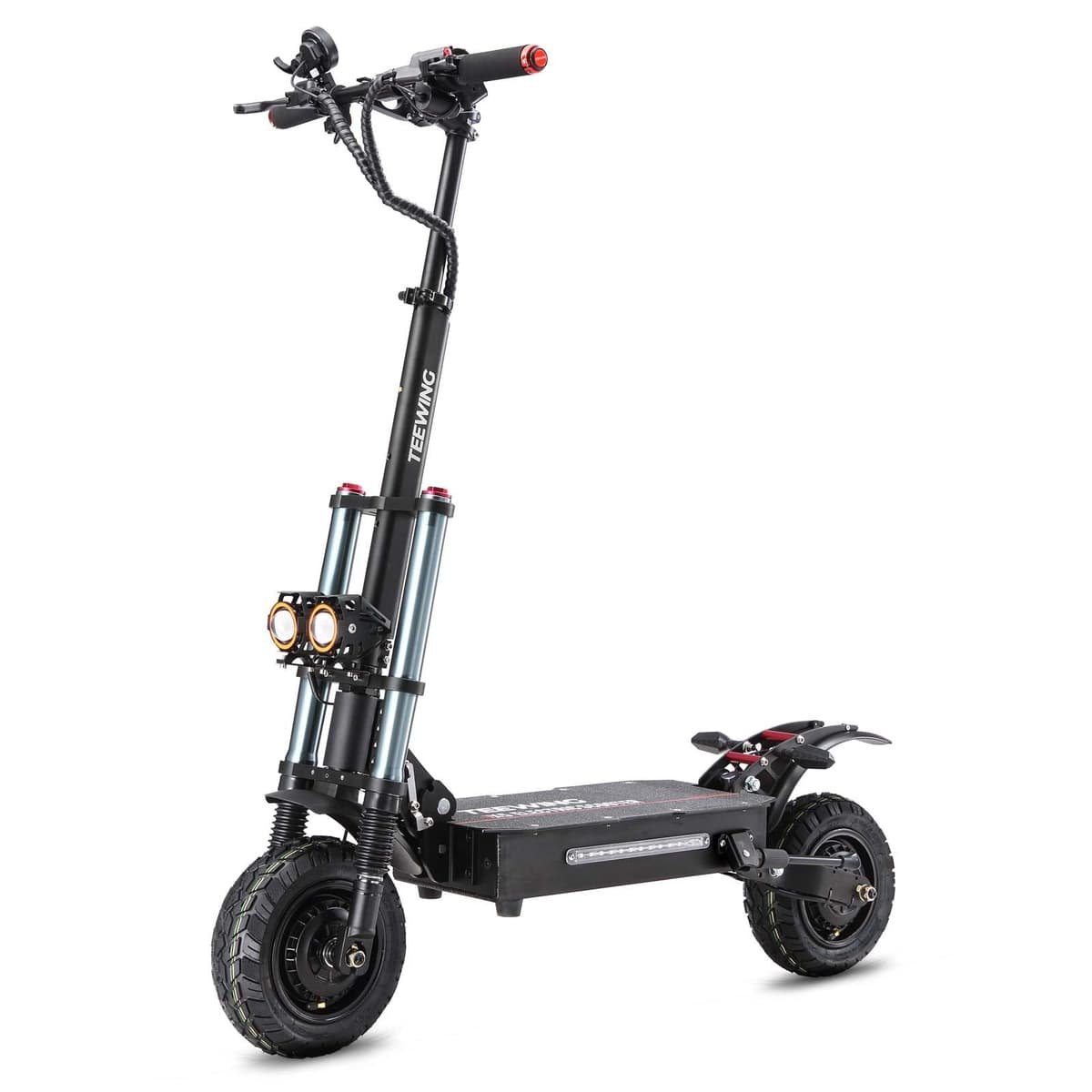
Suspension decides how a ride feels on real streets. Here is how spring, hydraulic and rubber setups differ, when one end is enough, and who can skip it.
The short answer
An electric scooter with suspension soaks up cracks, potholes and rough pavement, so the tires keep their grip and your knees and back take less of a beating. Spring suspension is simple and durable, hydraulic suspension adds oil damping that stops the bounce, and rubber (elastomer) suspension is compact and needs little care. Suspension front and rear, often called dual suspension, rides best. Look for it if your streets are rough, your rides are long or your tires are solid. On short, smooth trips with a scooter you carry a lot, you can do without.
Electric scooters roll on small wheels, so every crack and pothole reaches the deck. Suspension lets each wheel move up and down over a bump while the deck and handlebar stay steadier. That does three things for you:
Suspension comes in three main types, and it can sit at the front, the rear or both ends. Both choices change the ride.
Spring suspension uses a steel coil or a C-shaped spring that compresses over a bump and pushes back. It is simple, durable and needs little care, and you will find it from mid priced commuters to dual motor models. The trade off is bounce: without damping, a spring can keep rebounding after a big hit or over a run of bumps.
The ASAP 10D pairs front and rear spring suspension with 10 x 3.0 inch air tires. The Kaabo Urban uses C-type springs front and rear on 8.5 x 3.0 inch tubeless tires, and the Teverun Blade Mini Ultra uses dual spring suspension on a dual motor frame.
Hydraulic suspension adds oil damping to the spring. The oil slows how fast the shock compresses and rebounds, so the scooter settles after a bump instead of bouncing. It feels calmer at speed and over broken pavement, and it usually costs more. Product pages may call it an oil shock, a hydraulic spring or hydraulic damping.
Many hydraulic setups adjust, so you can tune them for your weight and your roads:
Rubber suspension uses a block or cartridge of elastomer that squashes over a bump. It is compact, light and close to maintenance free, which is why it shows up on commuter models. It moves less than a spring or hydraulic shock, so it takes the edge off cracks and expansion joints rather than deep potholes.
The Segway E3 Pro uses elastomer suspension front and rear and weighs 40.1 lbs. The Segway F3 mixes a hydraulic front with a rear elastomer, and the JOYOR S10-S-Z All-Terrain uses front and rear elastomer suspension with 10-inch off-road tires.
Where the suspension sits matters as much as the type.
Suspension earns its weight when:
You can do without it when your trips are short and smooth and you carry the scooter up stairs or onto a train every day. Suspension adds weight and moving parts, and large air filled tires already absorb a lot. The Segway F2 has no suspension and relies on 10-inch self-sealing tubeless tires. Our electric scooter wheel size guide explains how wheel size changes the ride.
Tires are the first layer of suspension. An air filled tire flexes over small bumps before the shock moves at all. The firmest ride is solid tires with no suspension. The softest is large air filled tires with hydraulic suspension front and rear. If you choose solid tires to avoid flats, choose suspension at both ends to go with them. Our guide to solid vs air filled tires compares the two.
Our maintenance checklist covers the bolts, brakes and folding latch to check at the same time.
Every model below lists front and rear suspension on its product page. They are grouped by type: spring first, then hydraulic, rubber and a mixed setup.
| Model | Top speed (mph) | Range (miles) | Motor power (W) |
|---|---|---|---|
| Kaabo Urban Electric Scooter | 25 | 25 | 500 |
| ASAP 10D Electric Scooter | 34 | 55 | 1,000 |
| Teverun Blade Mini Ultra Electric Scooter | 43 | 62 | 2,000 |
| Segway Max G3 Electric Scooter | 28 | 50 | 850 |
| E-TWOW TankTorq TK2 Lite Electric Scooter | 25 | 28 | 600 |
| Teverun Fighter Mini PRO Electric Scooter | 40 | 62 | 2,000 |
| Segway E3 Pro Electric Scooter | 20 | 34 | 400 |
| JOYOR S10-S-Z All-Terrain Electric Scooter | 37.3 | 46.6 | 1,000 |
| Segway Max G2 Electric Scooter | 22 | 43 | 450 |
Maker figures, checked September 2026. Real range and speed depend on rider weight, terrain, temperature and riding mode.
Looking for a light model to carry around campus? See our sibling guide to the electric scooter for college.
Browse every model in the electric scooter shop. Every order ships free to the lower 48 states, and you can split the cost with Pay in 4 at 0% APR or monthly payments with Affirm.
On rough streets or rides longer than a few minutes, yes. It improves comfort and keeps the tires gripping over bumps. On short, smooth trips with large air filled tires, you may not miss it.
Hydraulic suspension controls bounce better, so it feels calmer at speed and over repeated bumps. Spring suspension is simpler and very durable. For daily commuting at moderate speed, either works well.
Only a little, through the extra weight. Rider weight, speed, hills, tire pressure and temperature have a much bigger effect on how far you get.
Not in a practical way. Suspension is part of the frame and fork design. If your ride feels harsh, check the tire pressure first, or choose a model with suspension built in.
It means suspension on both the front and the rear wheel. Some makers use their own names for it, such as quad suspension or dual damping arms.
Prices run from light commuters under $500 to hyper scooters past $5,000. Here is what each band buys, what pushes the price up and what you spend after checkout.
72 volts is where electric dirt bikes start to pull like full-size motorcycles. Here is what the number changes, what it does not, and who should ride one.
The right first electric dirt bike is the one you can touch the ground on and control at low speed. Here is how to size it, how much power to start with and where to ride it.
30+ brands and 200+ models, with free shipping to the 48 contiguous states. Stuck between two? Our AI assistant answers calls and texts any time at (240) 916-2471.