Front vs full suspension electric bike: which one your roads need
A front fork handles most city riding. Full suspension pays off on broken pavement, gravel and trails, at the cost of weight and upkeep. Here is how to choose.
Published Nov 1, 20266 min read
TRAVEL
The short answer
In a front vs full suspension electric bike choice, a front suspension fork soaks up potholes and cracks at the handlebar, and suits most city and paved riding. Full suspension adds a rear shock, so the back wheel tracks rough ground and your lower back takes less of a beating on gravel, trails and broken streets. Full suspension adds weight and upkeep: Segway’s full suspension Xafari weighs 92.5 lb against 72.75 lb for its front suspension Myon. Pick front suspension for paved commutes and full suspension for rough, mixed ground.
Front suspension (a hardtail) is lighter, simpler and enough for most paved riding.
Full suspension adds a rear shock for comfort and grip on rough, mixed ground.
Travel, measured in millimeters, tells you how much bump a fork or shock can absorb.
A suspension seat post or fat tires can add comfort without full suspension.
What suspension does on an electric bike
Suspension lets the wheel move up and over a bump while the frame, and you, stay steadier. That keeps the tire on the ground for grip and braking, and takes the sting out of potholes, curbs and broken pavement.
It matters more on an electric bike than on a regular bicycle. E-bikes are heavier and often faster, and riders spend more time sitting on the saddle instead of standing over rough patches. Our guide to electric scooters with suspension covers spring, hydraulic and rubber designs, and the same ideas apply here.
No suspension
A rigid bike has no fork or shock and relies on its tires for comfort. It is lighter, cheaper to build and has nothing to service. Cargo and city bikes often go this way: the Segway MUXI lists no suspension and uses 20 x 3.0 in multi-surface tires instead. On smooth city streets and bike lanes, a rigid bike with wide tires rides well.
Front suspension
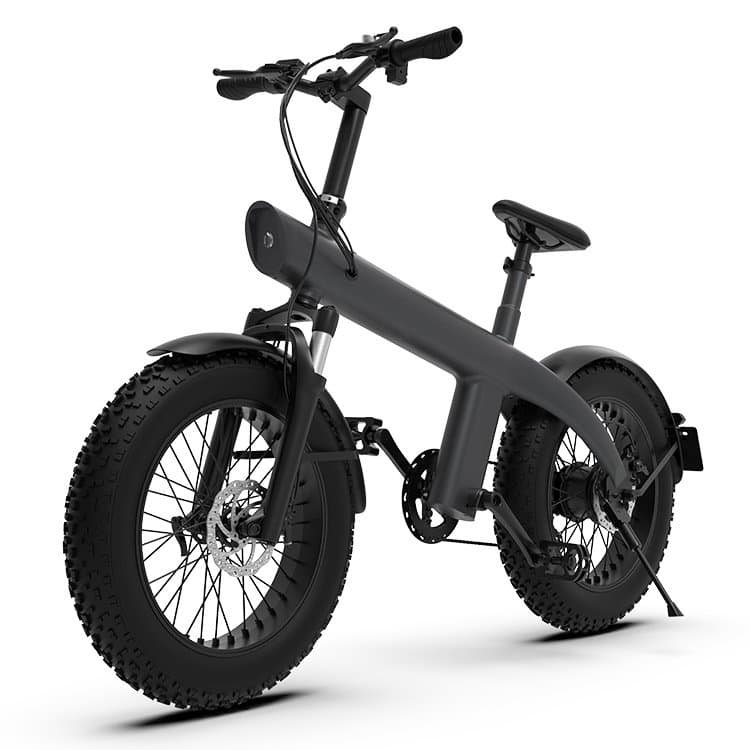
Front suspension uses a suspension fork, and a bike with a front fork and a rigid rear is called a hardtail. The front wheel takes most of the hits on a road, and a fork protects your hands, wrists and shoulders. Most electric bikes we carry use this setup.
Segway Myon: 80 mm of front travel on a commuter frame, at 72.75 lb.
Hiboy EX9: an 80 mm front fork on a 59.5 lb commuter.
NAVEE Wolf X: an 80 mm air fork plus a four-bar suspension seat post.
Segway MUXI Pro: 70 mm of front travel on a step-through cargo frame.
Speedway Riders Q3: a lockable double-tube suspension fork with 20 x 4.0 in fat tires, at 53 lb.
Front suspension suits paved commutes, bike lanes with the odd pothole, light gravel paths and riders who want to keep weight down.
Full suspension
Full suspension adds a rear shock and a linkage that lets the rear wheel move. The back wheel stays on the ground over roots, rocks and broken asphalt, and the saddle stops kicking you on every bump.
Hiboy EX11: an 80 mm lockout dual-crown fork and a 4-link rear suspension, on 26 x 4.0 in fat tires, at 99.2 lb.
Segway Xafari: 80 mm front and 70 mm rear travel on Kenda 26 x 3.0 in tires, at 92.5 lb.
Maker figures, checked September 2026. Real range and speed depend on rider weight, terrain, temperature and riding mode.
Travel, air and coil, and lockout
Travel is how far the fork or shock can compress, in millimeters. The e-bikes above list 70 to 100 mm, which is right for roads, paths and light trails. Longer travel absorbs bigger hits but adds weight and can feel soft on smooth pavement.
Coil (spring) forks are simple and durable. They suit most commuter and fat tire bikes.
Air forks, like the one on the NAVEE Wolf X, use a pressurized air chamber instead of a steel spring. They are lighter, and the firmness can be set to your weight with a shock pump, following the maker’s manual.
Lockout stiffens the fork so it stops moving. It is handy on smooth roads and climbs, where a bouncing fork wastes energy. The Hiboy EX11 and the Speedway Riders Q3 list a lockable fork.
Dual-crown forks clamp the fork legs above and below the head tube for extra stiffness. The Hiboy EX11 and Riding’times GT33 use one.
Comfort without full suspension
Not every comfortable ride needs a rear shock.
A suspension seat post takes the edge off bumps under the saddle. The NAVEE Wolf X comes with a four-bar suspension seat post, and the Hiboy C1 has a sprung seat.
Fat tires run at lower pressure and act as extra suspension. Our fat tire electric bikes guide covers the trade offs.
Full suspension adds parts, and parts add weight. Segway’s own lineup shows it: the full suspension Xafari weighs 92.5 lb, the front suspension Myon 72.75 lb. The Hiboy EX11 weighs 99.2 lb against 59.5 lb for the front suspension Hiboy EX9. If you carry the bike up stairs or onto a rack, that gap matters.
Suspension also needs care. Wipe the fork stanchions and rear shock clean after wet or dusty rides, check for oil on the seals, and look for play or knocking in the linkage. Follow the maker’s manual for any setup and service intervals, and take seal or damper service to a qualified bike shop. Our electric bike maintenance checklist covers the rest of the bike, and covered faults go through our warranty page.
Which setup suits you
Smooth paved commute: a rigid bike with wide tires, or a light hardtail such as the Hiboy EX9.
City streets with potholes: front suspension, such as the Segway Myon or NAVEE Wolf X.
Gravel, dirt and trails: full suspension, such as the Segway Xafari or Hiboy EX11.
Comfort on a budget: a fat tire bike with front suspension, or a full suspension ASAP model.
On rough ground, yes: it adds grip and comfort on gravel, trails and broken streets. On smooth paved commutes, front suspension is lighter and needs less upkeep.
How much suspension travel do I need on an e-bike?
For roads, paths and light trails, 70 to 100 mm is plenty. The commuter, fat tire and trail bikes in this guide list 70 to 90 mm at the front.
What is a hardtail electric bike?
A bike with a front suspension fork and a rigid rear. Most commuter and fat tire electric bikes are hardtails.
Does suspension reduce electric bike range?
Slightly. A soft fork or shock absorbs some of your pedaling effort, and full suspension adds weight. A lockout fork helps on smooth roads and climbs.
A 52V battery gives a little more punch than a 48V one at the same current, but range comes from watt hours, the speed cap stays the same and the whole system has to match.
A 750 W motor pulls harder up hills and away from lights than a 500 W motor, but it does not raise the speed limit, and torque often tells you more than watts.
The deck is where you stand for every mile. Its length, width and height decide how steady the scooter feels, how easily you step on and what it clears.
Nov 1, 20267 min read
Ready to look at models?
Shop the rides
30+ brands and 200+ models, with free shipping to the 48 contiguous states. Stuck between two? Our AI assistant answers calls and texts any time at (240) 916-2471.