Electric scooters by budget: what you get at each price
Each step up in price buys more battery, more motor and a sturdier build. Here is what to expect in each band, and how to tell which one your trip needs.
Published Oct 9, 20266 min read
BUDGET
The short answer
Under $500 buys a light commuter electric scooter for short, flat trips. From $500 to $1,000 you get more range, a stronger motor, suspension and better brakes, which suits most daily commuters. From $1,000 to $2,500 dual motors, hydraulic brakes and long range become the norm. Above $2,500 you are buying a heavy performance machine for experienced riders. Spend enough to cover your real trip, your weight and your hills, and no more.
The battery is the most expensive part, so more money mostly buys more range.
The band from $500 to $1,000 is where most commuters find the right balance.
Higher bands add speed and power, but also a lot of weight.
Budget for a helmet and a good lock too. They matter as much as the electric scooter.
Where the money goes
The battery is the biggest single cost in any electric scooter. A larger battery with good quality cells costs more, and needs a stronger frame to carry it. Then come the motor and controller, the brakes, suspension and tires, and the parts you do not see, such as the folding latch and wiring.
So as prices rise, you mostly pay for more range, more power and a build that can handle both. Apps, turn signals and bright displays are on models at every price and are not a sign of quality on their own.
Under $500: light commuters
Built for short, flat trips and easy carrying. Most models fold in seconds and weigh roughly 25 to 45 pounds.
Speed: most top out around 15 to 20 mph, with a few reaching the mid 20s.
Range: advertised figures of roughly 12 to 25 miles are typical, and a few models go further.
Motor: a single motor, often rated from 250 to 500 watts. Fine on flat ground, slower on hills.
Build: 8.5 to 10 inch tires, solid or air filled, one mechanical brake plus electronic braking, and little or no suspension. Maximum rider weight is often 220 to 265 pounds.
Best for riders under about 200 pounds with a flat trip of a few miles.
Maker figures, checked September 2026. Real range and speed depend on rider weight, terrain, temperature and riding mode.
$500 to $1,000: the everyday commuter
Where most daily commuters should look. A bigger battery, a stronger motor and a more comfortable ride, while most models still fold and can be lifted.
Speed: most reach 20 to 30 mph, and a few dual motor models near the top of the band go faster.
Range: advertised figures of roughly 25 to 50 miles are common.
Motor: single motors of around 500 to 1,200 watts, with the first dual motor models appearing toward $1,000.
Build: 10 inch air filled tires, suspension on many models, disc brakes front and rear, and brighter lights. Most weigh 40 to 70 pounds, with rider limits commonly 265 to 300 pounds.
Best for commutes of 5 to 15 miles each way, moderate hills and riders up to around 250 pounds.
Maker figures, checked September 2026. Real range and speed depend on rider weight, terrain, temperature and riding mode.
$1,000 to $2,500: power and long range
Dual motors, big batteries and serious brakes become the norm. These models climb steep hills, carry heavier riders and cover long distances. The trade off is weight.
Speed: many reach 40 to 55 mph, though some premium commuter models spend the money on range and ride quality instead of top speed.
Range: advertised figures of roughly 40 to 80 miles are common.
Motor: mostly dual motors, on higher voltage systems of 48V to 72V.
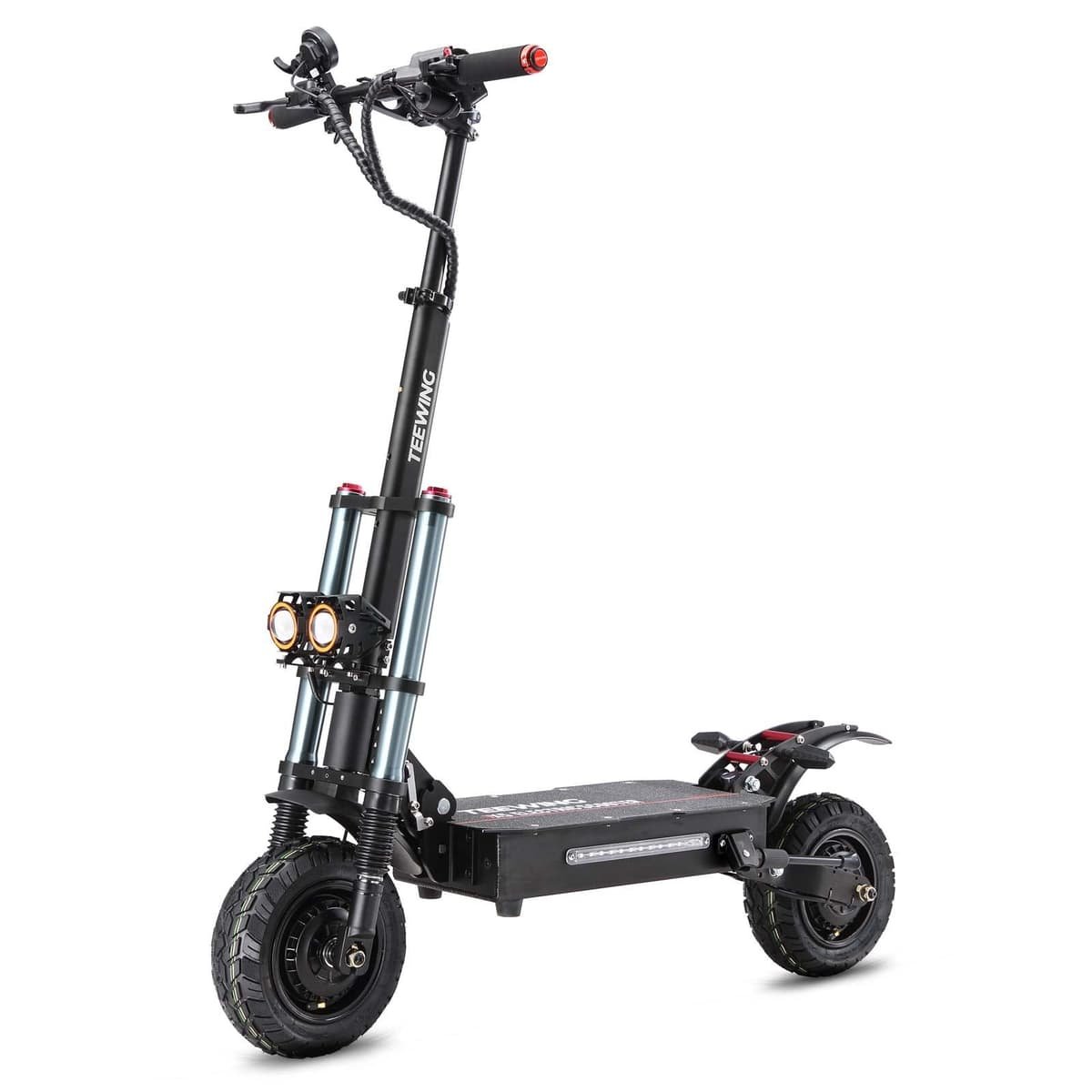
Build: hydraulic disc brakes on many models, adjustable suspension, wider tires and stronger stems. Weights of 60 to 100 pounds are typical.
Maker figures, checked September 2026. Real range and speed depend on rider weight, terrain, temperature and riding mode.
$2,500 and up: performance and flagship models
For experienced riders who want the most power, range and build quality. In speed and weight these are closer to a small motorcycle than a commuter.
Speed: 50 mph and up is common, and the fastest models go well past 60 mph.
Range: very large batteries, with advertised figures that often pass 60 miles and sometimes 100.
Motor: powerful dual motors on high voltage systems, with advanced controllers for smoother power.
Build: full hydraulic brakes, fully adjustable suspension, wide tires, stronger frames and premium lighting. Many weigh 90 to 150 pounds or more.
Best for experienced riders with room to store something this heavy and full protective gear. Where the rules are strictest, the fastest models are often limited to private land. Read how fast do electric scooters go before you choose this band.
Wear parts such as tires, tubes and brake pads, which faster and heavier models go through sooner.
Charging costs very little, only a few cents per charge for most models.
How to pick your band
Work out what your trip needs, then find the lowest band that covers it. Look for an advertised range about double your longest regular round trip, and a maximum rider weight at least 20% above yours with your bag. With steep hills, lean toward more power.
Do not buy more than you need. More speed and range mean more weight, and a model too heavy to carry or too fast for your roads is a worse choice, not a better one. Our guide to choosing an electric scooter walks through each decision.
Yes, for the right trip. For a short, flat ride and a lighter rider, a model in this band does the job well. For long distances, hills or a heavier rider, the next band up is usually the better buy.
What is a good amount to spend on a commuter electric scooter?
For most daily commuters, the band from $500 to $1,000 gives the best balance of range, comfort and weight. Spend more if your trip is long, hilly, or you weigh over about 250 pounds.
Why do some electric scooters cost so much more than others?
Mostly battery size, motor power and build quality. A bigger battery, dual motors, hydraulic brakes and adjustable suspension all add cost, and so does the stronger frame needed to carry them.
Can I spread the cost?
Yes. At checkout you can choose Pay in 4, which splits the cost into four payments at 0% APR, or a monthly plan, which usually carries interest. See our financing page for details.
Most scooters are sized for an average rider, which leaves shorter riders steering with raised arms and wrestling a heavy frame. Here are the figures that fix the fit, the models with adjustable handlebars, and our picks for short beginners.
Teens sit between kids bikes and full size adult bikes, and the right choice depends on height, weight and experience more than age. Here is how the teen-friendly models we carry compare, including what fits a 13 year old.
The max load on a spec sheet is a short number with a lot behind it. Here is what it covers, what changes as you get close to it, how much scooters and seated mopeds carry and weigh, and in-stock models at each rating.
Nov 12, 20268 min read
Ready to look at models?
Shop the rides
30+ brands and 200+ models, with free shipping to the 48 contiguous states. Stuck between two? Our AI assistant answers calls and texts any time at (240) 916-2471.