How much does an electric scooter cost? 2026 price guide
Prices run from light commuters under $500 to hyper scooters past $5,000. Here is what each band buys, what pushes the price up and what you spend after checkout.
Pay in 4 at 0% APRLearn more
Order by 2 PM ET · ships in 1–2 business days
14-day returnsSee the policy
Class, motor, battery, frame and fit. Five decisions cover almost everything, and the right answers come from the ride you will make most often.
The short answer
Start with the class your local rules allow: class 1 is pedal assist to 20 mph, class 2 adds a throttle up to 20 mph, and class 3 is pedal assist to 28 mph. Then pick a frame style for your trip, a motor type for your hills, and a battery with about double the watt hours your longest regular ride needs. Finish with fit, brakes and weight: a frame you can stand over, disc brakes, and a weight you can actually lift.
Most US states use a three-class system, and the class decides where you can ride. The classes are based on how the motor is switched on and the speed at which it stops helping.
Many states that use the classes also expect the motor to be rated at 750 watts or less. Some electric bikes are sold with more power, or with a setting that lifts the speed above the class limit, and that can take them outside the classes in some places.
Rules vary by state and city. Before you buy, check your state motor vehicle agency and your city website for where each class may ride, helmet rules and age limits. We cover the questions to ask in electric scooter laws: what to check before you ride, and most of them apply to electric bikes too.
Pedal assist adds power as you pedal. A throttle gives power at the push of a lever or twist grip. Pedal assist feels like riding with a tailwind and stretches the battery further. A throttle is handy for pulling away from a light or resting your legs.
A cadence sensor switches the motor on when the pedals turn, giving an easy, even push. A torque sensor measures how hard you press, so the help rises and falls with your effort. It feels more natural and usually comes on more expensive models.
For flat to rolling routes, a hub motor does the job well. For long, steep hills, or a ride that feels closest to a regular bicycle, look at a mid-drive. Makers list motor power as either a continuous or a peak rating, so two figures are not always measured the same way.
Watt hours tell you how much energy the battery holds. Multiply the voltage by the amp hours: a 48V 14Ah pack holds 672Wh. The higher the number, the further you can go, and the more the battery weighs.
Advertised range is usually measured in the lowest assist level, on flat ground, with a light rider. The throttle, high assist levels, headwinds and cold all bring it down. As a rough guide, an electric bike ridden with moderate pedaling uses around 15 to 30Wh per mile, and more on the throttle alone.
| Model | Top speed (mph) | Range (miles) | Motor power (W) |
|---|---|---|---|
| Hiboy C1 Folding Electric Bike | 20 | 26.2 | 648 |
| Hiboy EX9 Urban Commuter Electric Bike | 20 | 62 | 750 |
| Speedway Riders Q3 750W Fat Tire Electric Bike | 28 | 45 | 750 |
| Segway Myon Electric Bike | 28 | 80 | 1,500 |
| Segway Xafari Electric Bike | 20 | 88 | 750 |
| The Dodge Electric Bicycle | 28 | 74 | 1,000 |
Maker figures, checked September 2026. Real range and speed depend on rider weight, terrain, temperature and riding mode.
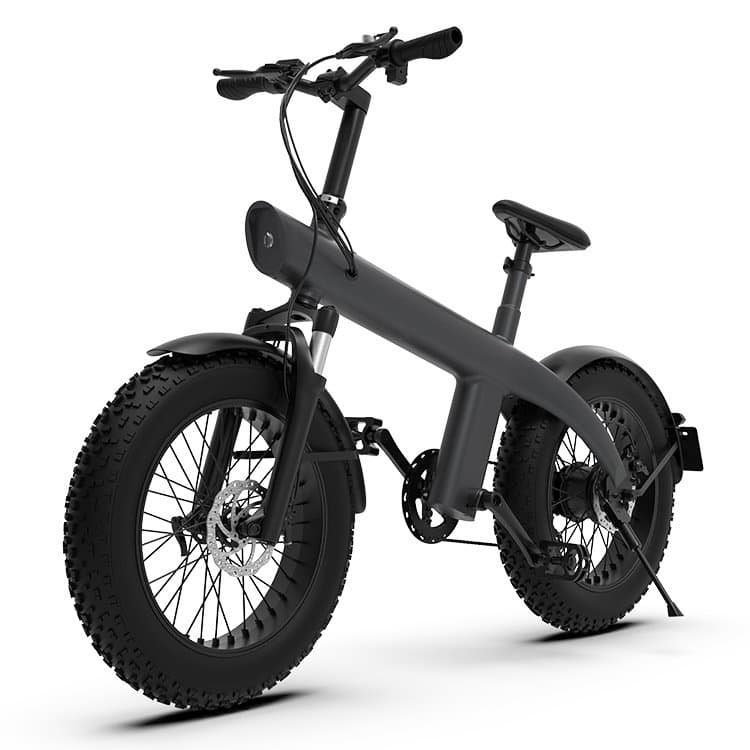
Many models mix styles, such as a fat tire step-through. Choose for the trip you make most often, not the one you take once a year.
An electric bike that fits is safer and far more comfortable. Most product pages list a rider height range. Start there.
Many electric bikes come in one frame size with an adjustable seat post, which suits most riders of average height. If you are very tall or quite short, check the listed height range carefully, or ask us before you order.
An electric bike is heavier and often faster than a regular bicycle, so the brakes matter. Look for disc brakes on both wheels. Hydraulic discs need less hand effort and stay consistent on long descents. Mechanical discs work well and are easy to adjust at any bike shop. Most models also have brake levers that cut the motor the moment you pull them.
Most electric bikes weigh 50 to 80 pounds, and fat tire and cargo models can go well past that. On flat ground you will never notice. Up stairs, into an elevator or onto a car rack, you will. Taking the battery out makes lifting easier, and any car rack needs to be rated for the weight. In a walk-up, a lighter commuter or folding model may suit you better than a bigger battery.
Browse every model in the electric bike shop. Still deciding between an electric bike and an electric scooter? Read electric scooter vs electric bike. Every order ships free to the lower 48 states, and you can split the cost with Pay in 4 or a monthly plan.
Related guides: Hub vs mid drive motor: how each e-bike motor works, climbs and rides and Throttle vs pedal assist: how each e-bike mode works and who it suits.
In many states an electric bike that fits one of the three classes is treated much like a bicycle, with no license or registration. Rules vary by state and city, so check your state motor vehicle agency before you ride.
Class 1 is allowed in the most places. Class 2 adds a throttle for easy starts. Class 3 suits longer road commutes but is kept off some paths. Choose the class that fits the roads and paths you will actually use.
Neither is better for everyone. A hub motor is simpler, needs less upkeep and suits flat to rolling routes. A mid-drive climbs steep hills better and feels more like a regular bicycle.
A lithium-ion battery slowly loses capacity over hundreds of charge cycles, and with good care it lasts several years. Our battery care guide covers charging and storage, and the advice applies to electric bikes too.
Prices run from light commuters under $500 to hyper scooters past $5,000. Here is what each band buys, what pushes the price up and what you spend after checkout.
72 volts is where electric dirt bikes start to pull like full-size motorcycles. Here is what the number changes, what it does not, and who should ride one.
The right first electric dirt bike is the one you can touch the ground on and control at low speed. Here is how to size it, how much power to start with and where to ride it.
30+ brands and 200+ models, with free shipping to the 48 contiguous states. Stuck between two? Our AI assistant answers calls and texts any time at (240) 916-2471.