Drum brake vs disc brake electric scooter: which one suits your riding
Drums hide inside the wheel and ask almost nothing of you. Discs sit in the open, bite harder and need a little care. Here is how to pick between them.
Published Nov 1, 20268 min read
DRUM
The short answer
In the drum brake vs disc brake electric scooter choice, a drum brake wins on low upkeep and steady wet weather stops, because its parts are sealed inside the wheel hub. A disc brake wins on stopping power and heat control, so it stays strong on long hills and at higher speeds, but it needs more regular checks. For a commuter up to about 20 mph, a drum paired with a motor brake works well. Faster riders and hilly routes call for discs on both wheels.
A drum brake is sealed inside the hub, so rain and grit barely change how it feels.
A disc brake clamps an open rotor, which gives a sharper bite and sheds heat faster.
Many scooters mix the two, such as a front disc with a rear drum, or a drum paired with an electronic brake.
Never convert one brake type to another yourself. Brake work belongs with a qualified technician.
The difference in one minute
Both brakes turn your speed into heat through friction. They differ in where that friction happens.
Drum brake: two curved shoes sit inside a drum built into the wheel hub. Squeeze the lever and a cam pushes the shoes outward against the spinning drum.
Disc brake: a flat steel rotor is bolted to the wheel. Squeeze the lever and a caliper clamps pads onto both faces of the rotor. On most commuter scooters a cable moves the caliper (a mechanical disc). Faster models often use fluid instead (a hydraulic disc).
That one design choice drives everything else: how hard each brake bites, how it copes with water and heat, and how often you need to touch it. For the full family of scooter brakes, including foot brakes and hydraulic systems, read our guide to electric scooter brakes. This guide sticks to the two friction brakes most shoppers weigh against each other.
Stopping power and feel
A disc brake usually stops harder for the same squeeze at the lever. The pads grip a rotor with a large swept area, and the caliper can clamp with real force. You feel a clear bite point and can feather the brake with fine control.
A drum brake feels softer and more gradual. The shoes press on a small surface inside the hub, so there is less leverage. Many riders like that gentle feel in stop and go traffic, and it is less likely to lock a small wheel if you grab it in a panic. The trade off is a longer stop from the same speed.
On most scooters the difference matters most at the front, where your weight shifts as you slow down. That is why so many makers put the stronger brake up front: ASAP fits a front disc and rear drum to both the ASAP A9 and the ASAP 10 V1.
Rain, grit and road salt
Weather is where the drum brake earns its place. Its shoes and drum sit behind a sealed housing, so a wet street, a puddle or road grit barely changes the feel. The brake you have on a dry morning is the brake you have in a shower.
A disc brake works in the open. Water on the rotor can delay the bite for a moment until the pads wipe it clear, and grit or salt can wear pads and score the rotor faster. Oil is the real enemy: a drop of lubricant on a rotor can cut braking sharply, which is why you never spray lube near a disc.
Whatever brake you have, give yourself more room in the wet. Tires grip less on wet paint, metal covers and leaves. Our guide to riding in rain and winter covers wet braking and cold weather care.
Long hills and heat
Every stop makes heat, and a brake that cannot shed it gets weaker. This is called fade.
A disc brake has an advantage here. Its rotor spins in open air and cools as it turns, so it copes better with repeated hard stops and long descents. Larger rotors carry more metal to soak up heat: EMOVE lists 180 mm rotors for the mechanical discs on the EMOVE RoadRunner SE, and Kaabo lists a 4.7 in disc with EABS on the Kaabo Urban.
A drum traps its heat inside the hub. On a short city trip that never matters. On a long, steep hill ridden with the brake held on, a drum can fade sooner than a disc. If your route has a big descent, a disc at the front, or discs at both ends, is the safer pick.
Upkeep: what each brake asks of you
A drum brake asks for very little. The shoes last a long time because they are protected, and most of the year you only need to check the cable tension at the lever. When the shoes finally wear out, the job is harder than swapping disc pads, because the wheel has to come apart.
A disc brake asks for small, regular checks.
Cable stretch: on a mechanical disc, the cable stretches a little over the first weeks, so the lever travels further. The manual shows the adjuster to use.
Pad wear: pads wear faster than drum shoes, especially in grit and rain. Our guide to electric scooter brake pads shows when to replace them.
Rotor care: keep the rotor clean and straight. A bent rotor rubs and squeals.
Alignment: a caliper that sits off center can drag. If the noise or drag stays after a basic clean, have it looked at.
Power the scooter off before you touch any brake, and follow the maker’s manual. Anything beyond a lever adjustment, such as replacing cables, bleeding hydraulic lines or swapping shoes, belongs with a qualified technician. If a brake fault appears on a new scooter, check what our warranty page covers before you pay for a repair.
Common combinations on real scooters
Few scooters use one type of brake alone. Here is how makers in our catalog combine them:
Front drum with a rear electronic brake. The NAVEE GT3, the Segway E3 Pro and the Segway Max G2 all use this layout. It is light, simple and suits commuter speeds.
A drum and an electronic brake on one lever. Hiboy lists electronic regenerative braking and a drum worked by one lever on the Hiboy S2 MAX.
Drums at both ends. Dualtron fits dual drums to the Dualtron Compact, which keeps both brakes sealed inside the hubs.
Front disc with a rear drum. The ASAP A9 and 10 V1 use this mix, and the NAVEE ST3 pairs a front drum with a rear disc and EABS.
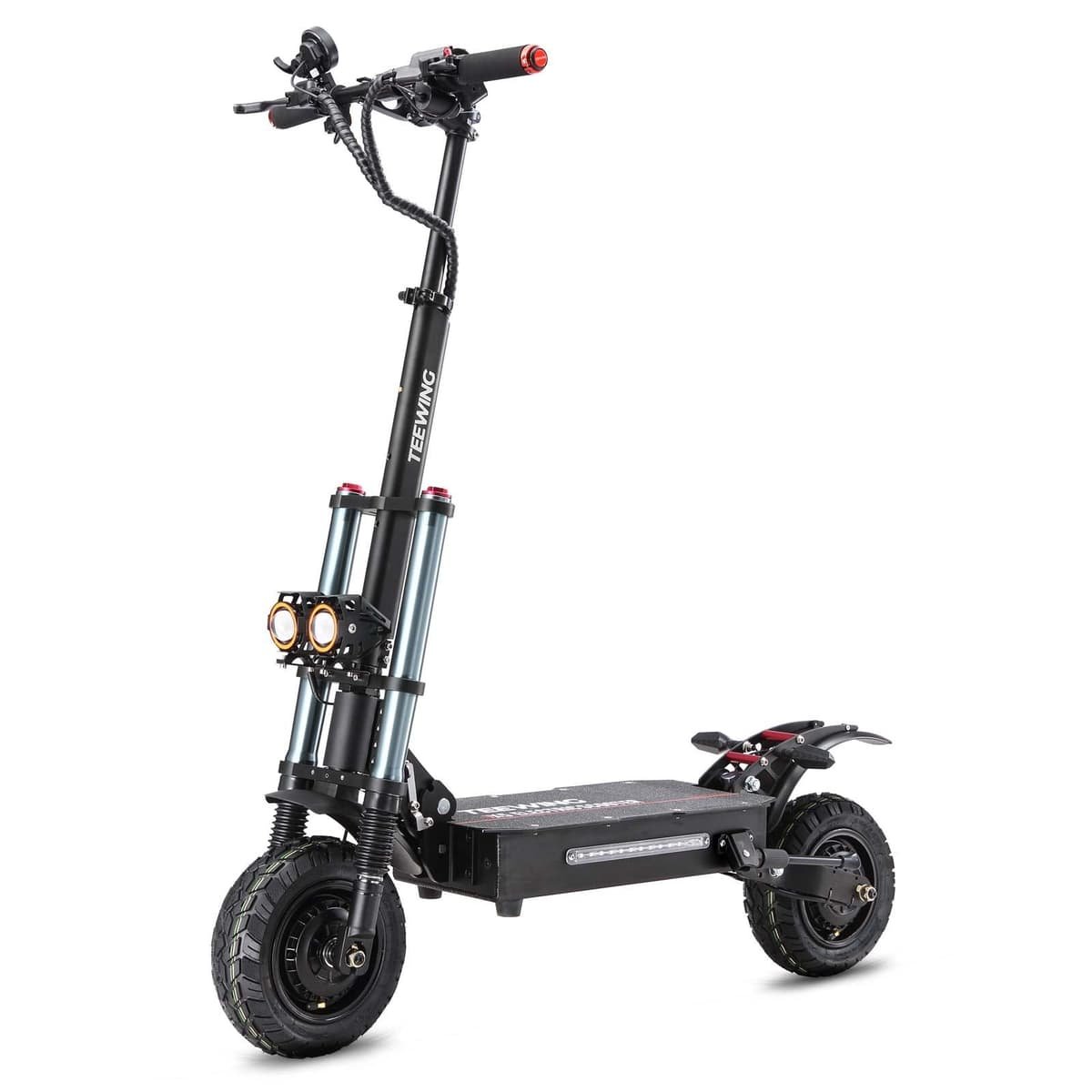
Mechanical discs at both ends. The NANROBOT G3 and the Teewing GT2 stop with mechanical discs, and the KUKIRIN G2 lists front and rear discs.
Hydraulic discs. The next step up. The NANROBOT G4 uses dual hydraulic discs.
From drums to discs: NAVEE GT3 and Segway E3 Pro (front drum, rear electronic), INMOTION S1F (drum and electronic), ASAP A9 and 10 V1 (front disc, rear drum), NANROBOT G3 and Teewing GT2 (mechanical discs) and NANROBOT G4 (hydraulic discs)
Maker figures, checked September 2026. Real range and speed depend on rider weight, terrain, temperature and riding mode.
Most of these models also cut motor power the moment you pull a brake lever, so the motor never pushes against you during a stop. Electronic braking is a topic of its own. Our sibling guide on electric scooter regenerative braking explains how it works and how much charge it really returns.
Which one should you choose?
Short, flat city trips up to about 20 mph, little time for upkeep: a drum, usually paired with an electronic brake, is a sensible choice.
Lots of rain, salt or grit: drums keep the same feel in bad weather. If you pick discs, plan on more frequent cleaning and pad checks.
Hills, heavier riders or speeds above about 20 mph: discs on both wheels. A front disc with a rear drum is a reasonable middle ground for moderate speeds.
Above about 30 mph: look at hydraulic discs front and rear.
Do not try to swap a drum for a disc, or add a brake, yourself. Brake mounts, wheels and controllers are designed together, and a home conversion can leave you with a brake that fails when you need it. Choose the brake setup you want at the time you buy.
Browse every model in our electric scooter collection, or our commuter electric scooters guide for daily riders. Every order ships free to the lower 48 states, and you can spread the cost with Pay in 4 at 0% APR on scooters priced $2,000 or less, or a monthly plan with Affirm, subject to approval, on our financing page.
Questions riders ask
Are drum brakes safe on an electric scooter?
Yes, at the speeds they are built for. A drum brake stops more gently than a disc, but it stays consistent in the rain and needs little care. Most commuter scooters pair a drum with a second brake, such as an electronic brake on the other wheel.
Do disc brakes stop faster than drum brakes?
Usually, yes. A disc brake bites harder for the same lever pull and resists fade on long hills. Your tires, the road surface and your technique matter too, so practice hard stops in an empty lot.
Can I upgrade my scooter from drum to disc brakes?
We do not recommend it. Brake mounts, wheels and controllers are designed together, and a home conversion can fail when you need it most. Choose the brake setup you want when you buy, and leave brake work to a qualified technician.
How often should I adjust my scooter’s brakes?
Check them before every ride by squeezing each lever. Look at cable tension and pad wear about once a month, more often with discs in wet or gritty weather. Our maintenance checklist has the full routine.
Why does my drum brake feel weak?
A stretched cable is the usual cause, and the lever adjuster in the manual often fixes it. If the lever still pulls close to the handlebar, the shoes may be worn. Power off and have a qualified technician check it.
Parking a scooter for the cold months takes about an hour, and doing it right means it starts in spring with a healthy battery. Here is the full layup routine, the monthly check, and the spring restart.
Charging an electric bike takes a minute of your time and a few hours of the charger's. Here is a simple routine, what decides how long it takes, how to charge a removable battery, and the signs that mean stop.
A motor does not make gears pointless. Here is how electric bike gears work with pedal assist, how many you need, how to shift without grinding, and how to keep the chain and gears running smoothly.
Nov 1, 20267 min read
Ready to look at models?
Shop the rides
30+ brands and 200+ models, with free shipping to the 48 contiguous states. Stuck between two? Our AI assistant answers calls and texts any time at (240) 916-2471.