Long range electric scooter guide: 50+ mile models, battery size and real range
Two scooters rated for 50 miles can carry very different batteries. Here is how to read the watt hours, the test speed and the weight before you pick a long range model.
Published Oct 9, 20268 min read
MILES
The short answer
A long range electric scooter is one the maker rates for 50 miles or more, and our in-stock options run from the 52.8 lb INMOTION S1F (675Wh, 59 miles) to the 137 lb Teverun Fighter Supreme Ultra 2.0 (124 miles at 15 mph). Compare battery watt hours, not just miles: lighter models reach 50+ miles on paper because makers test them at low speeds. At everyday speeds, a bigger battery is what really goes the distance, and it brings more weight and longer charging.
Watt hours (volts times amp hours) are the fairest way to compare two long range models.
Check the test speed: several makers rate range at 9.3 to 15.5 mph or in an eco mode.
Long range models we stock weigh from 52.8 lb to well over 100 lb. More battery means more weight.
Big batteries take longer to charge unless the scooter has a fast or second charger.
What counts as long range
We call an electric scooter long range when the maker rates it for 50 miles or more on one charge. Dozens of the electric scooters we stock qualify, from commuters just over 50 pounds to performance models rated past 100 miles.
Long range suits a long commute with no charger at work, several trips in one day, weekend rides, or simply charging less often. A bigger battery also works through fewer full charge cycles for the same miles, which helps it last. Our guide on how long electric scooter batteries last explains charge cycles.
Watt hours (Wh) measure the energy in the pack: multiply the volts by the amp hours. A 60V 21Ah battery holds 1,260Wh. Because every maker tests range a little differently, watt hours tell you more than the miles do.
Try dividing each battery by its rated range. It shows how many watt hours the maker assumes you use per mile:
INMOTION S1F: 675Wh for 59 miles, about 11Wh per mile.
NAVEE GT5 Max: 596.7Wh for 55.9 miles at 9.3 mph, about 11Wh per mile.
E-TWOW TankTorq TK5: 1,260Wh for 50 miles. E-TWOW lists consumption of 19.3Wh per mile.
Segway GT3 Pro: 2,160Wh for 86 miles in ECO mode, about 25Wh per mile.
A very low figure per mile usually points to a gentle test, not a magic motor. At normal commuting speeds, most riders use around 20 to 30Wh per mile on a commuter model, and more on a fast dual motor scooter, as our guide to real range vs the advertised number explains. By that measure, a 600 to 700Wh scooter covers roughly 20 to 35 real miles, while a 1,260Wh battery covers roughly 40 to 60.
Rated range vs real range
Read the small print next to the range figure. Several makers state the speed or mode they tested at:
Air resistance climbs steeply with speed, so riding at 20 to 25 mph uses far more energy than 9 mph. A rider who cruises near top speed on a model rated at 9.3 mph may see around half the rated figure, or less in the cold and on hills. A rating measured at 15 mph is closer to real riding, which makes it easier to plan around.
Plan with a margin. Pick a rated range about double your longest regular round trip. Then a cold morning, a headwind or an aging battery will not leave you short of home.
The weight trade-off
Range is heavy. Cells add pounds, and a bigger pack needs a stronger frame, bigger brakes and better suspension to carry it. The long range models we stock fall into three weight groups.
Under 60 lb, with about 600 to 720Wh. These still fold and can be lifted for a few steps:
INMOTION S1F: 52.8 lbs, 675Wh, front and rear suspension, 10-inch air tires, a 30% hill climb and a 308 lbs maximum load.
NAVEE GT5 Max: 54.7 lbs, 596.7Wh, 10-inch tubeless tires, TCS traction control, a 286 lbs maximum load and IPX5.
Segway Max G3: 54.2 lbs, 597Wh, hydraulic suspension front and rear, front and rear disc brakes and IPX6.
Segway Max G3 Plus: 56 lbs, 717Wh, double hydraulic suspension, piston disc brakes, 11-inch self-sealing tires and IPX6.
Maker figures, checked September 2026. Real range and speed depend on rider weight, terrain, temperature and riding mode.
65 to 85 lb, with about 700 to 1,800Wh. Comfortable for long days, best kept on the ground floor:
Teverun Blade Mini Ultra: 65 lb with a 60V 27Ah (1,260Wh) battery, two 1,000W motors and full hydraulic disc brakes. It ships limited to 15.5 mph, per Teverun.
NAVEE UT5 Max: 75 lbs, 716Wh, 12-inch self-healing tubeless tires, dual hydraulic suspension and a 330 lbs maximum load.
EMOVE Cruiser V2: 74 lb as a single motor or 85 lb as the AWD, with a 30Ah battery at 52V or 60V, quad suspension and a 330 lb rider limit.
E-TWOW TankTorq TK5: 76 lbs, 1,260Wh, a 1,000W motor in each wheel, adjustable hydraulic suspension and IPX7.
ASAP 10D: 82 lbs, a 48V 22.5Ah (1,080Wh) battery, two 1,000W motors and disc brakes on both wheels.
Maker figures, checked September 2026. Real range and speed depend on rider weight, terrain, temperature and riding mode.
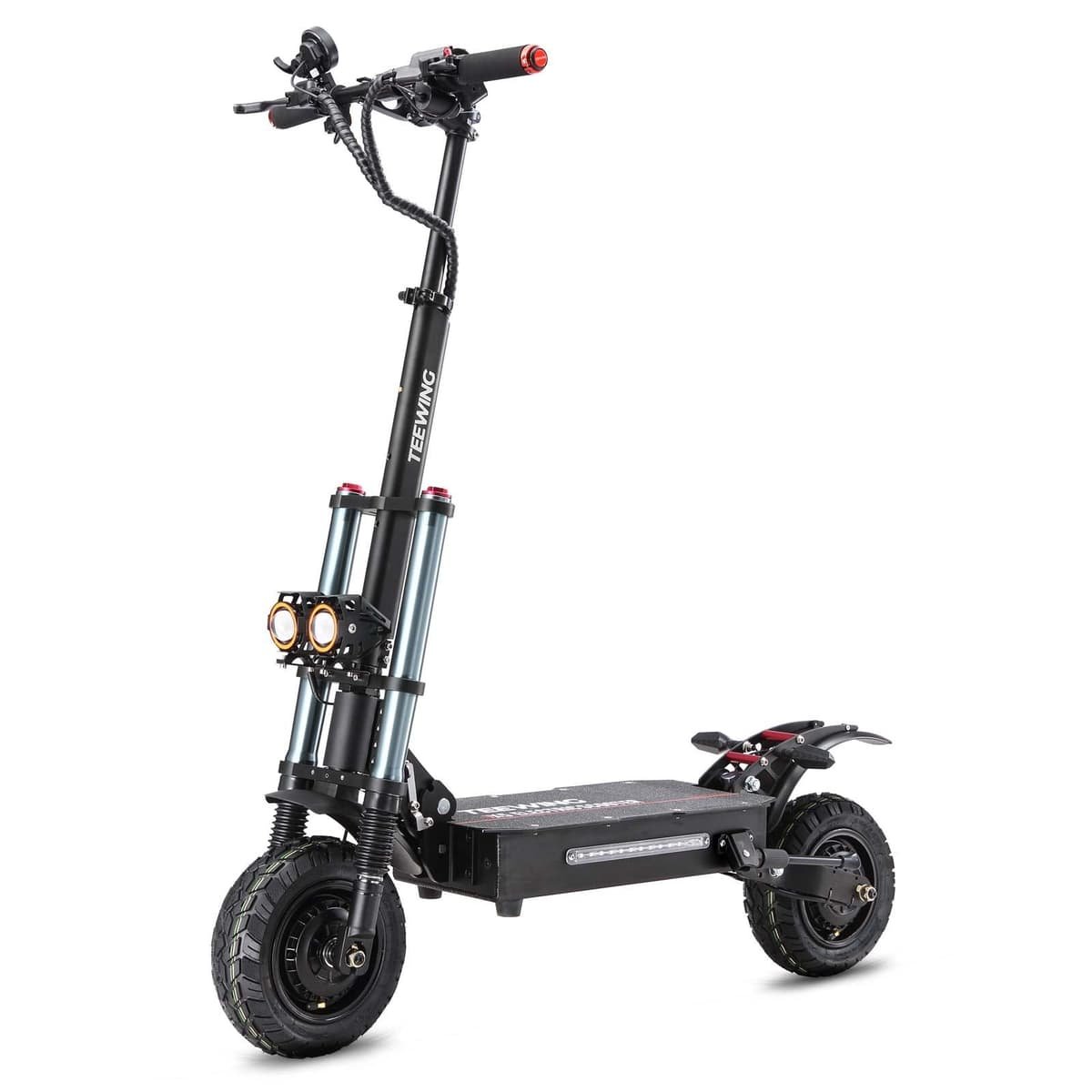
Over 100 lb, with about 1,700Wh and up. These are for experienced riders with a garage or a ramp. The Hiboy TITAN PRO weighs 103.6 lbs with a 48V 36Ah battery rated for 80 miles. The Segway GT3 Pro weighs 117.1 lbs with 2,160Wh, and the Teverun Fighter Supreme Ultra 2.0 weighs 137 lb with a 72V 60Ah battery rated for 124 miles at 15 mph. The JOYOR E6-S weighs 108 lbs and its 60V 31.5Ah (1,890Wh) battery comes out for charging.
Maker figures, checked September 2026. Real range and speed depend on rider weight, terrain, temperature and riding mode.
If you have to carry your scooter up stairs, a 75 lb model is a two-person job. Our sibling guide to the lightest electric scooters covers the other end of the trade-off.
Charging a big battery
Bigger packs take longer to fill, unless the scooter comes with a faster or second charger. The makers’ figures:
The INMOTION S1F takes 7 hours on its 42V 2A charger.
The Segway Max G3 Plus has a built-in 209W fast charger and fills in about 4 hours.
The ASAP 10D takes 9 hours or more, and the EMOVE Cruiser V2 takes 9 to 12 hours.
The Kaabo Warrior 11 Max, rated for about 93 miles, comes with two chargers and takes about 10 hours, or about 3.5 hours with two 5A chargers.
The Teverun Fighter Supreme Ultra 2.0 comes with an 84V 5A fast charger.
Charging overnight covers most of these. Use only the charger the maker supplies or approves, and read our battery care guide for safe charging and storage.
How to choose a long range electric scooter
Long commute with a few steps at one end: a model under 60 lb, such as the INMOTION S1F or the Segway Max G3 Plus.
Long commute with ground floor storage: the NAVEE UT5 Max or the E-TWOW TankTorq TK5, for more battery and comfort.
Heavier riders: check the maximum load. The S1F lists 308 lbs, and the UT5 Max and EMOVE Cruiser V2 list 330.
Experienced riders who want the most miles: the Segway GT3 Pro, the JOYOR E6-S or the Teverun Fighter Supreme Ultra 2.0, with the weight that comes with them.
Among the models we stock that ship in 1-2 business days, the Teverun Fighter Supreme Ultra 2.0 and the Kaabo Wolf King GTR Max are both rated for up to 124 miles. WEPED builds a few models rated for more, made to order with a longer wait.
Will a scooter rated for 50 miles really go 50 miles?
Only in conditions close to the maker’s test, which is often a low steady speed in an eco mode. At commuting speeds, with stops, hills and cold weather, plan on noticeably less, and compare watt hours to see which battery really holds more.
How much weight does a bigger battery add?
A lot. The 675Wh INMOTION S1F weighs 52.8 lbs, the 1,260Wh E-TWOW TankTorq TK5 weighs 76 lbs and the 2,160Wh Segway GT3 Pro weighs 117.1 lbs.
Does a bigger battery last longer?
For the same miles, usually yes. Each ride uses a smaller share of a big pack, so it goes through fewer full charge cycles a year. Good charging habits matter just as much.
Most scooters are sized for an average rider, which leaves shorter riders steering with raised arms and wrestling a heavy frame. Here are the figures that fix the fit, the models with adjustable handlebars, and our picks for short beginners.
Teens sit between kids bikes and full size adult bikes, and the right choice depends on height, weight and experience more than age. Here is how the teen-friendly models we carry compare, including what fits a 13 year old.
The max load on a spec sheet is a short number with a lot behind it. Here is what it covers, what changes as you get close to it, how much scooters and seated mopeds carry and weigh, and in-stock models at each rating.
Nov 12, 20268 min read
Ready to look at models?
Shop the rides
30+ brands and 200+ models, with free shipping to the 48 contiguous states. Stuck between two? Our AI assistant answers calls and texts any time at (240) 916-2471.